Dienstag, 29. April 2014

Science Flight #1 - April 28


On Saturday we finally had good conditions for a first science flight. The preparation for the takeoff was handicapped by the cold temperatures below -15°C. As many instruments never operated in such harsh conditions before, we encountered a couple of problems. Hard disks failed to boot, pumps did not warm up, connections to the instruments did not work. This took us a lot of additional time for checking the instruments before start. Heating up the cabin with a huge heat blower with nickname Herman Nelson, the situation improved so we were ready to fly. Unfortunately, all the heating did lower the aircraft battery so that the engines were not able to start. Recharging the batteries took us another hour until we finally took of towards the Beaufort Sea where a small but interesting cloud field with horizontal convective rools was probed. 


The measurement strategy was that Polar 5 sampled the cloud in situ while Polar 6 cruised far above and observed the cloud with remote sensing techniques. The coordination of the aircraft worked very well. The pilots adjusted the speed of both aircraft so that the horizontal distance was about 2 min at 120 kn flight velocity. So we were all happy that already with the first flight we collected a first very promising set of data. 

The clouds were generated above the "open" water. "open" because it again started to freeze due to the low temperature of the last two days. With easterly winds the clouds were blown further west above closed sea ice. Close to the US border they disappeared and so we turned around not to cause any trouble.

Winter struck back


Weather above the Arctic circle can change fast and and very significant. After sun shine and almost T-shirt weather on Friday temperatures dropped, wind increased and snow began to fall again. With such bad weather a science flight was not possible. Most of us spend the day for further system checks of the instruments what was quite a tough task as our aircraft remain outside at any time. 


To protect our self from the uninviting temperatures and the strong wind we could lent special polar clothes in advance of the campaign from the AWI. The clothes were packed in kitbags and shipped directly to Inuvik. The sizes we could test in advance in Bremerhaven. Hidden behind the fake fur the your field of view was a little narrow but nose and skin kept warm.

Teaching among scientists

Although we have quite a few seats for instrument operators in the two aircraft there will never be enough seats for all volunteers. Polar 6 hast tree comfortable mission seats and two additional benches each made for two passengers. Having eleven individual large instruments on board this is still not enough so that we have to share our duties during the flights and operate also other instruments than our own. After the certifications flights the two major groups operating the cloud particle measurements and the group running aerosol and trace gas sensors internally met and had a brief introduction to the other instruments. Fortunately, the Aurora Research Institute provides provides specials lab only made for this purpose ;) 

Certification Flight Polar 6 - April 26th


Short after the arrival of Polar 6 also the PMS probes arrived in Inuvik. Only one week from Oberpfaffenhofen to Northern Canada. That was quick regarding the two official Easter holidays in Canada. The boxes were soon unpacked and in  record-breaking time, the equipment was installed on Polar 5. First ground test have been made already on Friday. For all our surprise, all probes basically worked after the long journey, except some non-critical Ethernet problems. With all system running we could perform two short test flights which were required for the final certification of the Polar 6 science configuration. The first flight last about one hour with an ascent up to 10.000 ft. The second flight was much shorter. With 15 min between takeoff and landing it was just a quick circle around the airport. Between the two flights we exchanged one additional probe and rotated also the science crew to let everyone test its own instrument. During the first flight even some clouds with ice crystals could be observed by the PMS probes what we did not expect from the weather forecast but was a fortunate coincidence. So the HaloHolo probe recorded its first holograms of ice crystals. 


Sonntag, 27. April 2014

Lunchtime in Inuvik


After an early start in the day and hours of work on P5 and P6 at the airport, a proper lunch is highly appreciated by everybody.
During the campaign, it is provided by Joey Watters of Inukshook Catering at Aurora College. Hot soup, salads, wraps, sandwiches, chicken - he always comes up with new delicious combinations.


After having had lunch directly at Aurora College the first two days, from now on Joey is serving it directly at Aurora Research Institute. This way, everyone is more flexible which is a huge advantage especially for those working at the airport. Of course, lunchtime is always a good occassion to catch up with other groups or just to relax a bit.
Thanks Joey, we all enjoy your cooking!

Freitag, 25. April 2014

Little Mackenzie


While today the sun was almost burning so that the melting snow forms small streams everywhere in town, we continued preparing for the certification flight of Polar 6. The PMS probes were unpacked and tested in lab and at the aircraft. Cabin instruments were also tested and repaired thoroughly so that despite of some problems we are almost ready to have Polar 6 in the air tomorrow.  Although the warm temperatures of up to 7°C are not what we have and still do expect for ideal measurements, it really helped to work on the aircraft. Screwing, wire testing and calibrating without gloves was highly appreciated.

Donnerstag, 24. April 2014

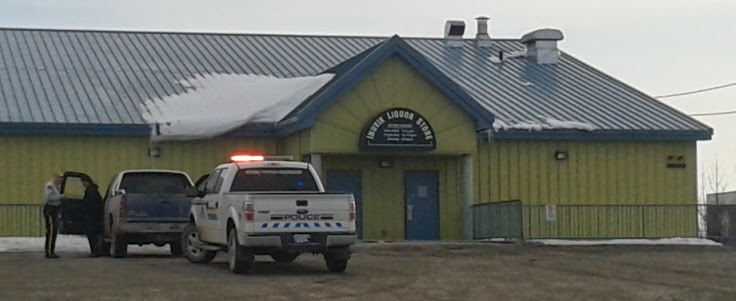
Tatort Inuvik

Today at 8:40 pm in front of the liquor store. What might have happened here? Robbery? Drunken Driving?

What we already could conclude is that the liquor store is a quite busy and often visited place in town.